Browse First: How Curiosity Unlocks Ideas You Can't Plan For
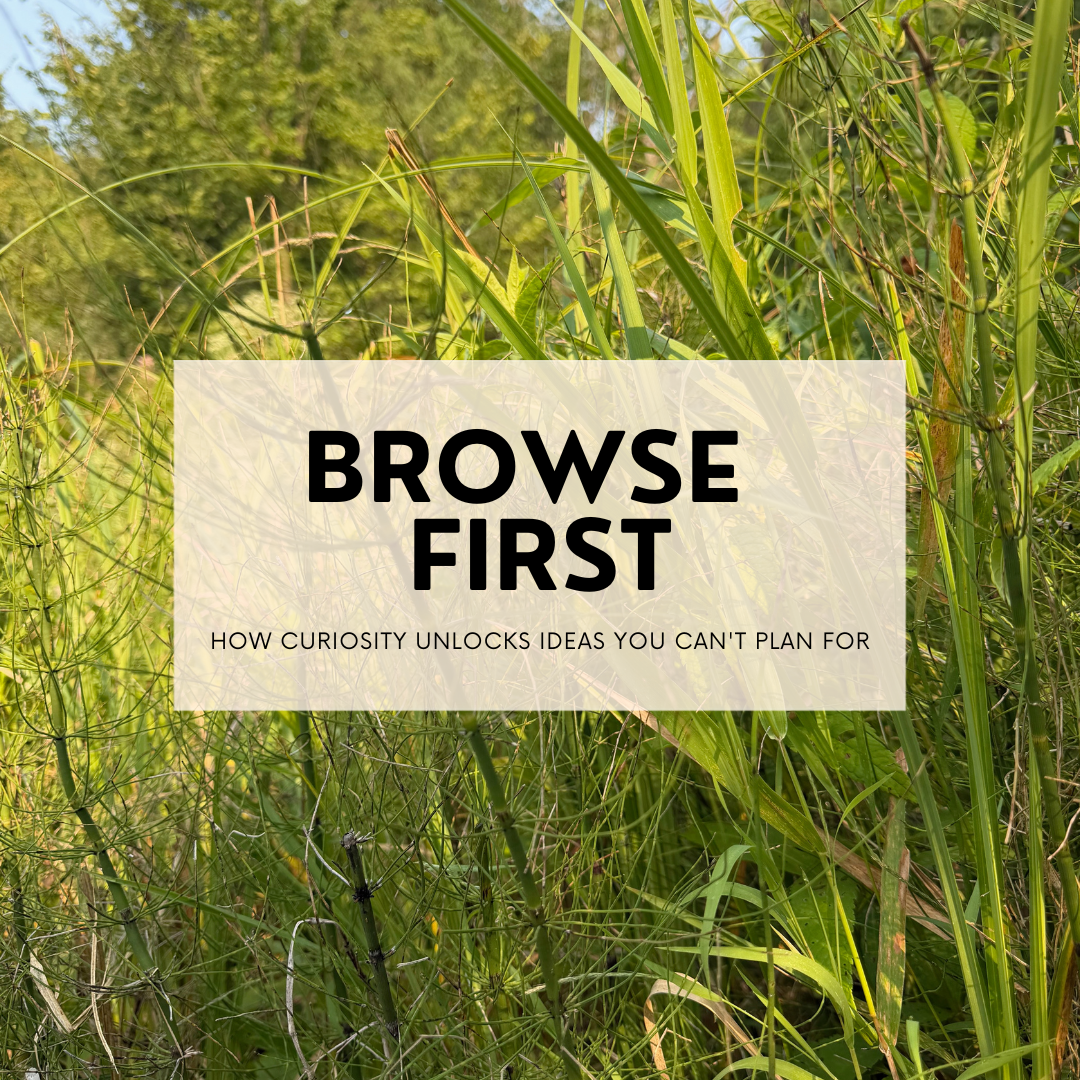
Most of us learned to search as an antidote to our questions. Type the right words, get the right answer. We got very good at it. Now we prompt instead. A lot.
You describe what you want, get something somewhat articulate back, and the exchange feels like thinking. But it’s still retrieval. You asked a question shaped by what you already suspected, and you got an answer shaped like your question. You walk away validated.
That’s a big part of why we keep landing on the same ideas.
I was on a nature walk recently as part of a workshop. The exercise was seemingly simple —
“Notice your surroundings the way you did when you were a kid.”
I couldn’t do it. Not at first. Whatever channel a five-year-old is tuned to, mine had gone dormant years ago.
So I cheated. I stopped trying to be a child and started thinking about my daughter, and what she would do out here. She would pull the horsetail plant apart to see how it is made. She would ask if she could eat the berries (I would say no!).
The walk changed.
Here’s what I noticed in that moment. A walk in the woods is naturally a browsing experience. No destination, no results page, nothing to retrieve. Yet, I was still searching that day, hunting for the right way to do the exercise.
The reflex is adaptive. It’s also limiting. And it follows you everywhere. Into the woods, and definitely into a conference room.
Searching is a skill. Browsing is a posture.
In The Anatomy of a Breakthrough, Adam Alter describes the distinction between searching and browsing. Searching is goal-directed: you have a question, you go get the answer. Browsing is open-ended. You wander. You stumble upon.
Think about ordering a book online versus wandering a bookstore. Online, you leave with exactly what you came for. In the store, you leave with the book you came for and possibly something off a display you’d never have thought to look for. That second book is the one you didn’t know you needed. It’s also the one you end up telling people about. This happened to me recently when I stumbled onto You Didn’t Hear This From Me: (Mostly) True Notes on Gossip by Kelsey McKinney. (It totally changed my mind about gossip and I have since recommended it to many!)
Here’s the issue. We spent twenty years building tools that reward searching, and the last few building tools that reward it faster and more fluently. We’re chronically hunting for the answer we suspect is already out there. That’s a comfortable place to be. Our brains prefer consistency, and information that contradicts what we believe creates friction, so we gravitate toward evidence that reassures us we were right all along.
But the best ideas are rarely sitting in the search bar or the chat window.
Curiosity gets weaned out of us.
Alter cites a number that astounded me: five-year-olds ask 200 to 300 questions a day. Adults ask 20 to 30. By adulthood we’ve kept about 10% of the curiosity we started with. (Ten percent!)
Along the way we learn that asking questions signals you don’t know, and that not knowing is risky and potentially expensive. In meetings. In performance reviews. In rooms where you were hired to have answers. Narrowing early keeps you efficient, and it keeps you safe.
But every time we narrow before we need to, we take in a little less. Less new information. Fewer perspectives that don’t already match our own. Fewer ideas that don’t have a home in our heads yet. We’re not less capable than we were at five. We’re just working from a smaller pool of inputs. And we rarely notice what’s missing.
That’s the same muscle I couldn’t find on the trail. Handed an open prompt with no right answer, I went hunting for one anyway instead of allowing myself to simply wander.
In my work with teams, I see this most clearly at the start of design sprints and ideation sessions. A product team arrives with the query already typed: How do we increase adoption?How do we turn one-time buyers into repeat customers?
Nearly everyone in that room already has an answer in mind. The feature they’ve been waiting to propose. The campaign they pitched last quarter. The pricing change they’re sure would work if someone would just let them try it.
Browsing on purpose…
Browsing takes intention. And intentional time set aside. It means holding a question open longer than is comfortable and looking down paths you haven’t been down before.
TRY THIS:
Before your next working session, block 20 minutes with no agenda.
Spend the time browsing:
Customer notes nobody’s read.
A competitor’s product.
A market you don’t operate in.
A book outside your field.
The only rule is that you are not allowed to be looking for anything specific. If you catch yourself reaching for a conclusion, keep going.
Heading into fall
Planning season has a gravity to it. You’re expected to arrive with a point of view, a number, a plan, and the pressure to show up with answers starts weeks before the meeting does.
I get it. I get paid to help teams move through exactly this and leave with a plan they’ll actually use. The plan matters. The number matters. I am not making a case for wandering instead of deciding.
I’m making a case for wandering before you decide. Twenty minutes of browsing doesn’t replace the planning work. It determines whether you spend the next quarter answering the right question. Both. In that order.
Because the leaders who find ideas nobody else finds usually didn’t search harder. They browsed first, then narrowed, and they came back with something that wasn’t on anyone’s list.
Next month I’m taking a look at another important aspect of curiosity: curiosity as a resilience tool when things are hard and moving fast.
In the meantime, if you’re heading into planning season and want a browse session built into the design, send me a note. It’s one of my favorite things to facilitate.
Did you enjoy this post? Clap to let me know. It helps me know what to write more of!
Join my monthly newsletter? I share exclusive tips and resources to run better workshops, accelerate teams, and uncover new ideas. You’ll hear from me 1–2 times a month.