How to Make Progress Without Consensus: Guiding People Through Misalignment
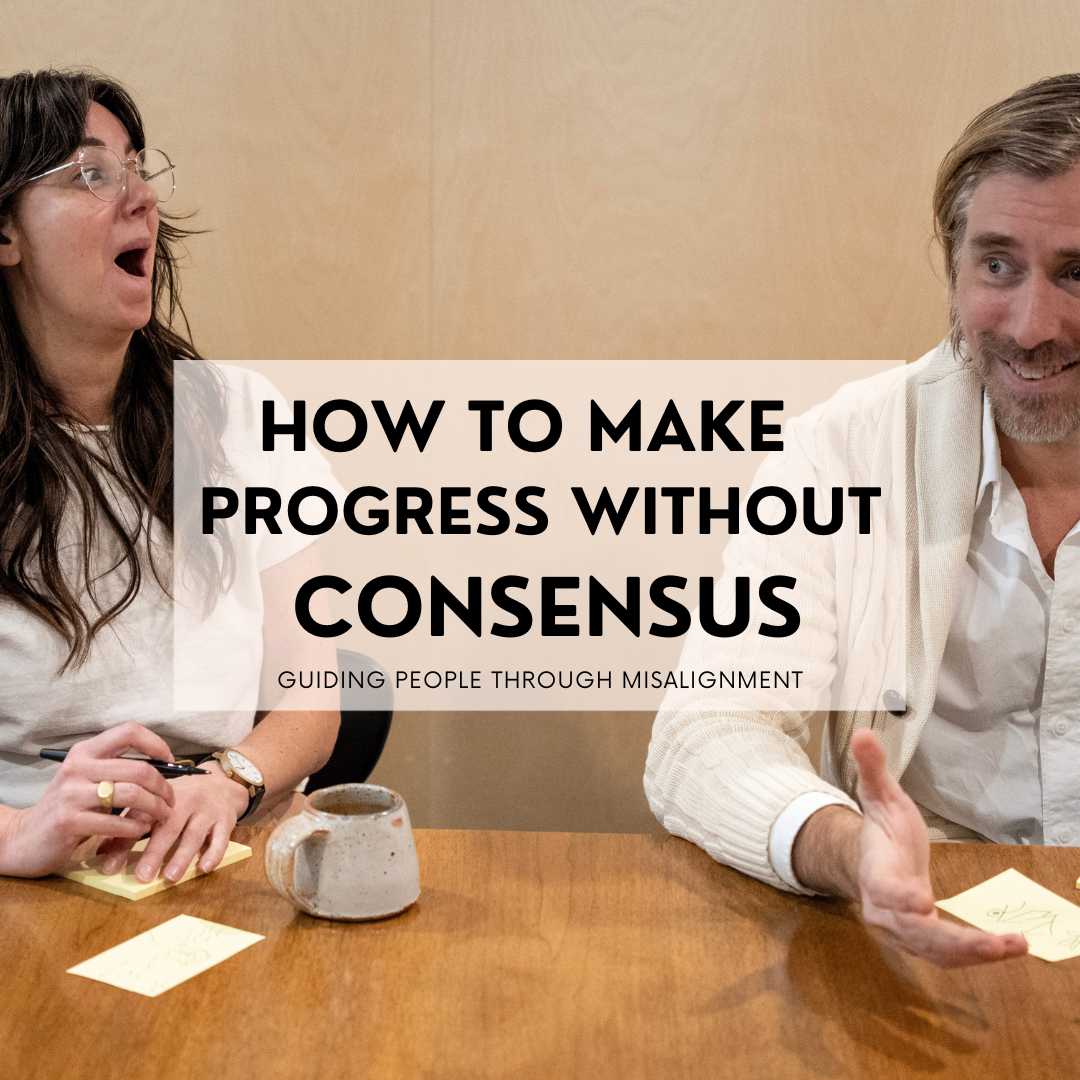
One of the biggest leadership traps is believing that progress requires consensus.
You navigate competing perspectives every day, from engineering, design, and sales, to customers, C-suite peers, and board members. They all see problems through different lenses. The instinct is often to keep pushing for alignment until everyone agrees.
In my work helping teams navigate ambiguity, I've noticed the teams that struggle most aren't usually lacking talent or information. They're often stuck waiting for a level of consensus that may never come.
Meaningful progress doesn't require everyone to see the world the same way. It requires enough shared understanding to move forward together despite those differences.
The challenge, then, isn't getting everyone to think alike. It's learning how to communicate, make decisions, and build momentum when they don't.
Here are three mindsets that will help you approach this conundrum with more ease and success.
1. Difference Shouldn’t Prevent Progress
I was recently listening to a Hidden Brain episode featuring social psychologist Robb Willer, and the topic was rooted in the idea that people often operate from entirely different identities, value systems, and information sources.
In organizations, we see a version of this every day.
Engineering may frame a problem around feasibility and scalability risk. Sales may frame it around revenue and urgency. Product may frame it around user value and long-term strategy.
It’s tempting to believe alignment requires everyone to fully understand and agree with each other’s perspective. In reality, that rarely happens.
After facilitating 100s of workshops, I’ve found that acknowledging differences without insisting on resolution often leads to more honest and respectful dialogue. We don’t need to fully align in order to move forward.
TRY THIS:
During conversations, redirect disagreement with a statement like:
“We may be looking at this from different angles, and that’s okay. Let’s focus on what decision we need to make together.”
Alignment doesn’t require identical thinking. It requires a shared willingness to move forward despite differences.
2. Shared Language Doesn't Mean Shared Meaning
One of the biggest communication challenges I see inside organizations actually isn't rooted in disagreement. It's rooted in unexamined assumptions about what words mean.
This isn’t just about abstract concepts. Even commonly-used terms can elicit head-nods, but the underlying meaning can vary dramatically depending on role or experience.
One of the simplest leadership practices you can implement is to slow down long enough to clarify meaning.
TRY THIS:
When jargon is used or disagreement arises during team collaboration, ask questions like:
“When you say XXXX, what do you mean? Can you use an analogy?”
“What would success look like from your perspective?”
“What would you like to say is true if we do this right?”
“Could you share a real-life example from our work to help me understand what you’re describing?”
These conversations often reveal that apparent conflict is actually a difference in interpretation.
Once that becomes visible, better decisions become possible.
(Pro tip: Use my asset inventory worksheet complete with an analogy menu to help you lead this clarity exercise, which you can download here.)
3. Connection and Conflict Can Coexist
We often behave as though disagreement threatens our ability to work together, but connection doesn't require agreement.
If this lands, you’ll like Adam Kahane’s body of work, whose writing on collaboration has deeply influenced how I think about change.
Kahane says that conflict and connection are not opposites.
We tend to assume that successful collaboration requires shared goals, shared perspectives, and shared understanding. In reality, most meaningful collaboration happens among people who: want different things; have different experiences; view success differently.
But we don't have to eliminate differences in order to work together.
And if we stop treating disagreement as a problem to solve, we can start treating it as a reality to navigate
In fact, some of the healthiest teams I've worked with have substantial disagreement. But a lot of consideration is required to navigate it. What does that look like?
TRY THIS:
Bring people together in a shared space, whether to convene for a meeting, attend a workshop, or simply talk. Even if disagreement remains, there's often a softening of assumptions. People start to see each other as more than their opinions.
This is one reason why cross-functional working sessions are so powerful. When people collaborate on real problems together, they have an opportunity to better understand and see the context behind each other’s priorities.
It becomes harder to reduce someone to “the engineering perspective” or “the sales perspective.” They become a person navigating constraints, just like everyone else.
That shift often unlocks better collaboration.
Progress Requires More Than Alignment
The more I think about progress, the less interested I am in achieving perfect alignment. Not because alignment isn't valuable, but because leaders rarely have the luxury of complete agreement.
The work still needs to move forward, products still need to ship, and decisions still need to be made.
What matters most is creating enough shared understanding to act while:
Acknowledging competing perspectives
Clarifying meaning before debating solutions
Creating opportunities for people to work through problems together
Staying connected even when agreement remains out of reach
That's often where progress begins. Not when everyone finally sees things the same way, but when they're willing to move forward together anyway.
If navigating team politics has felt impossible, send me a note. The bread-and-butter of what I do often involves helping high-conflict teams move forward with respect and integrity.
And if you want to check out the Hidden Brain episode I mentioned, or Adam Kahane’s latest book, click the hyperlinks!